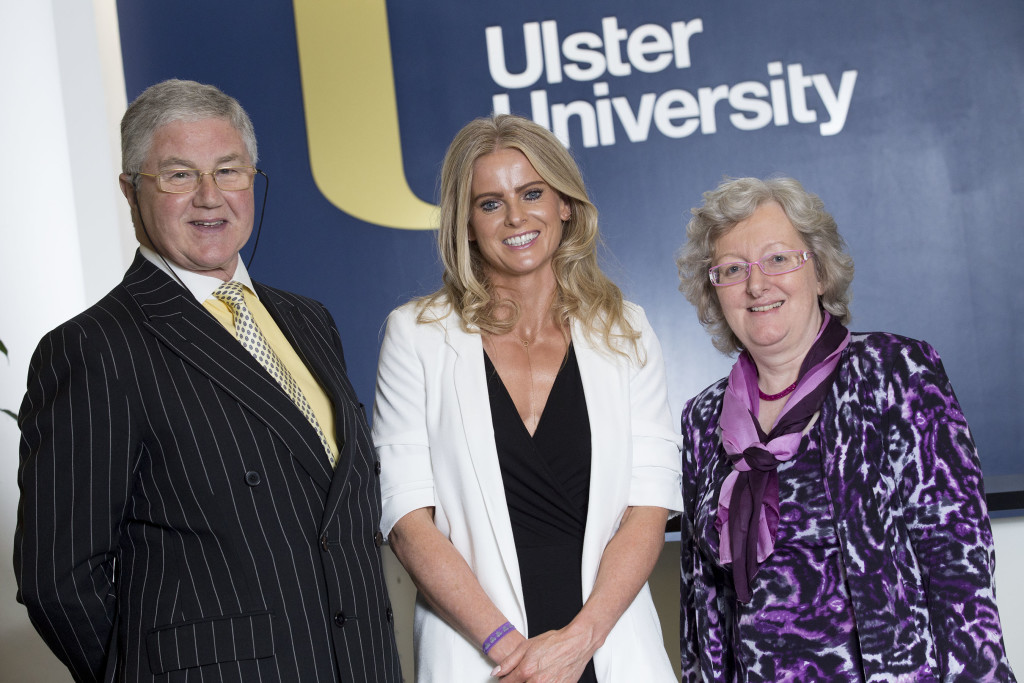
Professor Tara Moore with Professor John Marshall (Frost Professor of Ophthalmology at the Institute of Ophthalmology in association with Moorfield’s Eye Hospital, UCL) and Professor Carol Curran (Dean of the Faculty of Life and Health Sciences at Ulster University). (Photo: Nigel McDowell/Ulster University)
Tara Moore, Professor of Personalised Medicine, delivered her inaugural professorial lecture ‘Petunias, Worms and Bacteria – The ingredients to save vision’.
Philosophers, theologians and psychologists have debated the origin of humans since time immemorial. However, one truth we all accept is that many aspects of modern medicine are shaped by what we learn from single cell bacteria, too small to see, and phenomena we observe in worms or plants. Mechanisms of survival and response to infection reveal some of Nature’s best-kept genetic secrets, which scientists now use to develop novel therapies for human disease.
A failure by a plant scientist to produce intensely purple petunias ignited a revolution in genetics. Unwittingly, he had fallen upon a fundamental cellular mechanism that regulates which of our genes are switched on or off- an incredibly powerful molecular tool. Later molecular biologists Fire and Mello turned their attention to this conundrum, using a microscopic worm and their discovery of gene silencing resulted in award of their Nobel Prize in 2006. Known as RNAi, scientists now use it to control precisely any one gene out of a staggering 30,000 in our genome. Fascinatingly, in a new era, genome editing is now having incredible impact in the treatment of genetic disease by targeted genome editing.
The simplicity and programmability of these systems leave them amenable to adaptation for genome silencing and editing. This lecture explored research by Tara Moore and her team working toward a treatment for genetic blinding eye disease-a devastating disease that affected parents know they will pass on to half their children.
The response was given by Professor John Marshall, Frost Professor of Ophthalmology at the Institute of Ophthalmology in association with Moorfield’s Eye Hospital, UCL.